Multimodal Embeddings with Sentence Transformers

EmbeddingGemma 2 is a lightweight, open-source 740M parameter model designed for unified multimodal embeddings. Built on the Gemma 4 decoder architecture, it maps text, images, audio, and video into a single 768-dimensional vector space.
Because all modalities share the same semantic space, you can compare inputs within the same modality (e.g. image-to-image similarity) or across different modalities (e.g. text-to-image, text-to-audio, and text-to-video retrieval) locally on consumer GPUs or CPUs.
What this guide covers:
- Installing multimedia dependencies and loading EmbeddingGemma 2
- Selective modality loading to reduce GPU memory usage
- Image embeddings and cross-modal text-to-image search (with soft-token budget tuning)
- Audio embeddings and cross-modal text-to-audio retrieval
- Video embeddings and cross-modal text-to-video retrieval
- Interleaved multimodal inputs (combining text + images/audio/video in a single representation)
- Building a unified cross-modal search index across text, image, audio, and video
New to EmbeddingGemma 2?
For text-only basics, task prompts, zero-shot classification, RAG, and Matryoshka Representation Learning (MRL), start with the Generate Embeddings with Sentence Transformers guide.
Setup and Installation
Install sentence-transformers, transformers, and the multimedia libraries (pillow, soundfile, torchcodec) required for processing images, audio, and video.
Sentence Transformers is a Python framework for using and training embedding and reranker models. For more details on the framework, see the Sentence Transformers documentation.
Model Initialization
Instantiate EmbeddingGemma 2 directly using the SentenceTransformer class. By default, it loads the text backbone alongside both the vision and audio encoders.
from sentence_transformers import SentenceTransformer

model_id = "google/embeddinggemma-2"
model = SentenceTransformer(model_id)

print(f"device: {model.device}")
print(f"dtype: {model.dtype}")
print(f"Supported modalities: {model.modalities}")
print("Total number of parameters in the model:", sum(p.numel() for p in model.parameters()))
Loading weights:   0%|          | 0/1376 [00:00<?, ?it/s]
device: cuda:0
dtype: torch.bfloat16
Supported modalities: ['text', 'image', 'audio', 'video', 'message']
Total number of parameters in the model: 744371488
Note on Precision
EmbeddingGemma 2 activations are incompatible with float16. Always run inference in bfloat16 (default on supported GPUs) or float32.
Optional: Selective Encoder Loading
If your workflow only requires specific modalities (for example, audio-only retrieval), you can selectively load only the encoders you need via config_kwargs to optimize memory usage and initialization speed.
Pass "vision_config": None and/or "audio_config": None when initializing the model to load only the active encoders.
from sentence_transformers import SentenceTransformer

model_id = "google/embeddinggemma-2"
audio_only_model = SentenceTransformer(
    model_id,
    config_kwargs={"vision_config": None},
)

print("Total parameters (audio-only):", sum(p.numel() for p in audio_only_model.parameters()))
(For the remainder of this tutorial, we use the full multimodal model initialized above.)
Multimodal & Cross-Modal Embeddings
Because EmbeddingGemma 2 maps all modalities into a unified 768-dimensional vector space, you can compute similarity both within a modality (e.g., image-to-image) and across modalities (e.g., text-to-image, image-to-audio, or text-to-video).
Working with Images
Pass an image as a dictionary {"image": <source>}, where <source> can be a file path, URL, or PIL.Image object.
from PIL import Image
from IPython.display import display
import requests

IMAGE_SIZE = 240

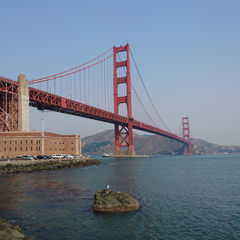
img_url = "https://raw.githubusercontent.com/google-gemma/cookbook/refs/heads/main/apps/sample-data/GoldenGate.png"
input_image = Image.open(requests.get(img_url, stream=True).raw).resize((IMAGE_SIZE, IMAGE_SIZE))

print("Input Image:")
display(input_image)

# Embed the image directly from a URL, file path, or PIL Image object
emb_goldengate = model.encode({"image": img_url})

# Compare the image embedding against another image and text candidates
example_img_url = "https://raw.githubusercontent.com/google-gemma/cookbook/refs/heads/main/apps/sample-data/kitchen_painting.jpg"
example_image = Image.open(requests.get(example_img_url, stream=True).raw).resize((IMAGE_SIZE, IMAGE_SIZE))

candidates = [
    {"image": example_img_url},
    "San Francisco",
    "a cute cat walking",
    "a friendly dog sitting in the grass",
]
emb_candidates = model.encode(candidates)
image_similarities = model.similarity(emb_goldengate, emb_candidates)[0]

print("\nSimilarity with candidates:\n"+"-"*80)
for idx, score in enumerate(image_similarities):
    if idx == 0:
        display(example_image)
    else:
        print(candidates[idx])
    print(f" `-> 🤖 score: {score:.3f}\n")
Similarity with candidates:
--------------------------------------------------------------------------------

 `-> 🤖 score: 0.585

San Francisco
 `-> 🤖 score: 0.641

a cute cat walking
 `-> 🤖 score: 0.534

a friendly dog sitting in the grass
 `-> 🤖 score: 0.509
Notice that the text query "San Francisco" achieves the highest cross-modal similarity with the Golden Gate Bridge photo.
Customizing Image Processing Parameters
You can adjust vision token budget per inference call via processing_kwargs:
img_processing_args = {
    "image": {
        "max_soft_tokens": 1120,
    }
}

emb_goldengate = model.encode({"image": img_url}, processing_kwargs=img_processing_args)
emb_candidates = model.encode(candidates, processing_kwargs=img_processing_args)
image_similarities = model.similarity(emb_goldengate, emb_candidates)[0]

print("Similarity with candidates:\n"+"-"*80)
for idx, score in enumerate(image_similarities):
    if idx == 0:
        display(example_image)
    else:
        print(candidates[idx])
    print(f" `-> 🤖 score: {score:.3f}\n")
Similarity with candidates:
--------------------------------------------------------------------------------

 `-> 🤖 score: 0.568

San Francisco
 `-> 🤖 score: 0.674

a cute cat walking
 `-> 🤖 score: 0.545

a friendly dog sitting in the grass
 `-> 🤖 score: 0.531
You can decide between budget sizes of 70, 140, 280, 560, or 1120 tokens. Increasing the vision budget for input images trades latency and token count for quality.
Working with Audio
Pass audio inputs as {"audio": <source>}. Supported audio sources include local file paths, URLs, or in-memory waveforms (1D/2D float32 NumPy arrays or PyTorch tensors). Audio files are automatically decoded and resampled to 16 kHz.
from IPython.display import display, Audio

aud_url = "https://ai.google.dev/gemma/docs/audio/roses-are.wav"

print("Input Audio:")
display(Audio(aud_url))

# Embed audio directly from a URL or file path
emb_speech = model.encode({"audio": aud_url})

# Compare audio embedding with text descriptions
candidates = [
    "a person speaking English",
    "random static white noise",
    "Roses are red, violets are blue.",
]
emb_candidates = model.encode(candidates)
audio_similarities = model.similarity(emb_speech, emb_candidates)[0]

print("\nSimilarity with candidates:\n"+"-"*80)
for idx, score in enumerate(audio_similarities):
    print(candidates[idx])
    print(f" `-> 🤖 score: {score:.3f}\n")
Similarity with candidates:
--------------------------------------------------------------------------------
a person speaking English
 `-> 🤖 score: 0.679

random static white noise
 `-> 🤖 score: 0.651

Roses are red, violets are blue.
 `-> 🤖 score: 0.876
Working with Video
Pass video inputs as {"video": <source>}. The model natively decodes MP4 files/URLs and samples video frames. You can also pass pre-extracted frames as a list of PIL.Image objects or 4D/5D tensors.
from IPython.display import display, Video

vid_url = "https://github.com/bebechien/gemma/raw/refs/heads/main/videos/cat_dozing.mp4"

print("Input Video:")
display(Video(vid_url))

# Embed video directly from a URL or file path
emb_video = model.encode({"video": vid_url})

# Compare video embedding with text descriptions
candidates = [
    "a cat dozing",
    "a cat playing with a small lizard",
    "a sports car racing on a highway",
]
emb_candidates = model.encode(candidates)
video_similarities = model.similarity(emb_video, emb_candidates)[0]

print("\nSimilarity with candidates:\n"+"-"*80)
for idx, score in enumerate(video_similarities):
    print(candidates[idx])
    print(f" `-> 🤖 score: {score:.3f}\n")
Similarity with candidates:
--------------------------------------------------------------------------------
a cat dozing
 `-> 🤖 score: 0.688

a cat playing with a small lizard
 `-> 🤖 score: 0.602

a sports car racing on a highway
 `-> 🤖 score: 0.440
Note on FPS
By default, video is processed as sampled frames through the vision encoder at 1 frame per second; FPS sampling rate is configurable.
Customizing Video Processing Parameters
You can adjust frame sampling behavior per inference call via processing_kwargs:
# Override video processing parameters for a specific encode() call
emb_video_custom = model.encode(
    {"video": vid_url},
    processing_kwargs={
        "video": {
            "max_frames": 16,               # Maximum frames to keep (default is 32)
            "fps": None,                    # Frames per second to extract (None keeps all up to max_frames)
            "overflow_strategy": "uniform", # How to sample when total frames exceed max_frames ('uniform' or 'truncate')
            "add_timestamps": True,         # Whether to insert frame timestamps into the multimodal sequence
        }
    },
)

video_similarities = model.similarity(emb_video_custom, emb_candidates)[0]

print("Similarity with customized video processing:\n"+"-"*80)
for idx, score in enumerate(video_similarities):
    print(candidates[idx])
    print(f" `-> 🤖 score: {score:.3f}\n")
Similarity with customized video processing:
--------------------------------------------------------------------------------
a cat dozing
 `-> 🤖 score: 0.739

a cat playing with a small lizard
 `-> 🤖 score: 0.668

a sports car racing on a highway
 `-> 🤖 score: 0.492
Interleaved Multimodal Inputs
EmbeddingGemma 2 supports rich, mixed-modality inputs within a single query pass:
- Multimodal dictionary: Pass multiple keys (
"text","image","audio","video") in the same dictionary to combine modalities automatically. - Explicit placeholder interleaving: Use
<|image|>,<|audio|>, and<|video|>tags inside the"text"string to control the exact token positions where media items are inserted.
img_url = "https://raw.githubusercontent.com/google-gemma/cookbook/refs/heads/main/apps/sample-data/GoldenGate.png"
example_img_url = "https://raw.githubusercontent.com/google-gemma/cookbook/refs/heads/main/apps/sample-data/kitchen_painting.jpg"
aud_url = "https://ai.google.dev/gemma/docs/audio/roses-are.wav"
vid_url = "https://github.com/bebechien/gemma/raw/refs/heads/main/videos/cat_dozing.mp4"

# 1. Multimodal query combining text, multiple images, and audio
query_multimodal = {
    "text": "Landmark and interior photos with spoken narration",
    "image": [img_url, example_img_url],
    "audio": aud_url,
}
emb_multimodal = model.encode(query_multimodal)

# 2. Interleaved query using placeholders to specify media ordering in text
query_interleaved = {
    "text": "Compare the scene in <|video|> with <|image|> and <|image|>.",
    "image": [img_url, example_img_url],
    "video": vid_url,
}
emb_interleaved = model.encode(query_interleaved)

# 3. Media-only interleaving using placeholders to control sequence order
query_media_sequence = {
    "text": "<|image|><|audio|><|image|>",
    "image": [img_url, example_img_url],
    "audio": aud_url,
}
emb_media_sequence = model.encode(query_media_sequence)

print("Multimodal embedding shape:", emb_multimodal.shape)
print("Interleaved embedding shape:", emb_interleaved.shape)
print("Media sequence embedding shape:", emb_media_sequence.shape)
Multimodal embedding shape: (768,)
Interleaved embedding shape: (768,)
Media sequence embedding shape: (768,)
Summary and Next Steps
You now know how to generate unified multimodal and cross-modal embeddings across text, images, audio, and video using EmbeddingGemma 2 and the sentence-transformers library, as well as how to configure modality encoders and customize video processing parameters.